
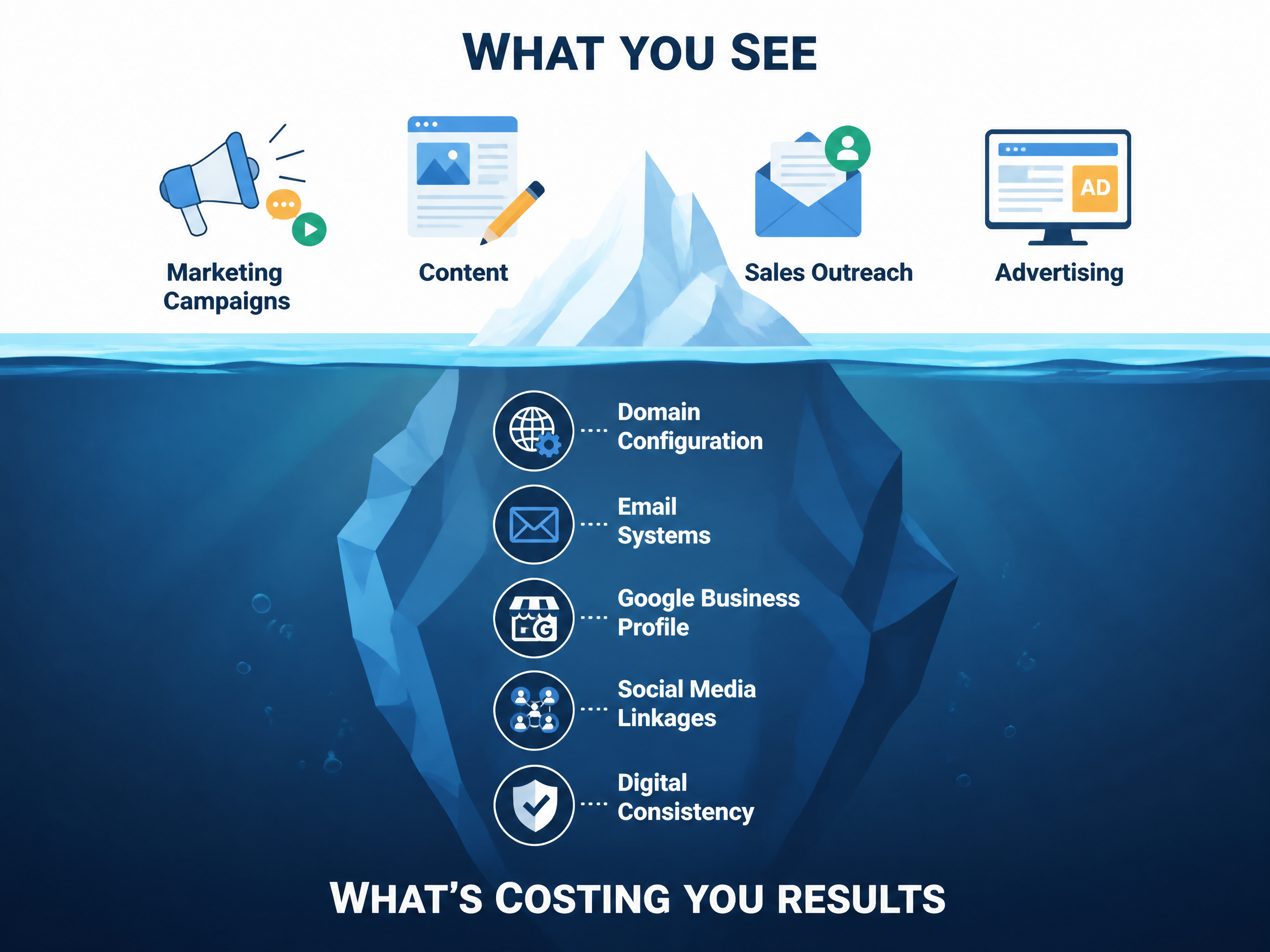
Many leadership teams invest substantial time and budget in marketing strategy, sales processes, content, and campaigns, yet results often fall short of expectations. The issue is rarely a lack of effort or creativity in the visible layers of marketing and sales. More frequently, the constraint lies deeper — in the technical foundations that support how a business presents itself across digital channels.
These foundations include domain configuration, email systems, Google Business Profile and related listings, social media account linkages, and the overall consistency of a company’s digital presence. When these elements are incomplete, inconsistent, or misaligned, they create friction that is difficult to see but increasingly costly to ignore.
The Shift in How Businesses Are Discovered and Evaluated
Search and recommendation systems are evolving. AI-driven platforms now assess sources not only on traditional ranking factors but also on signals of correctness, completeness, and overall reliability. These systems increasingly evaluate a business across its entire digital footprint rather than isolated channels.
When technical elements are fragmented, the resulting signals can appear less coherent. This does not just affect traditional search rankings. It influences how AI agents surface and recommend businesses to decision-makers. Organizations with technically sound and consistent foundations are more likely to be perceived as reliable and current. Those with gaps risk reduced visibility and weaker trust signals at the point of discovery.
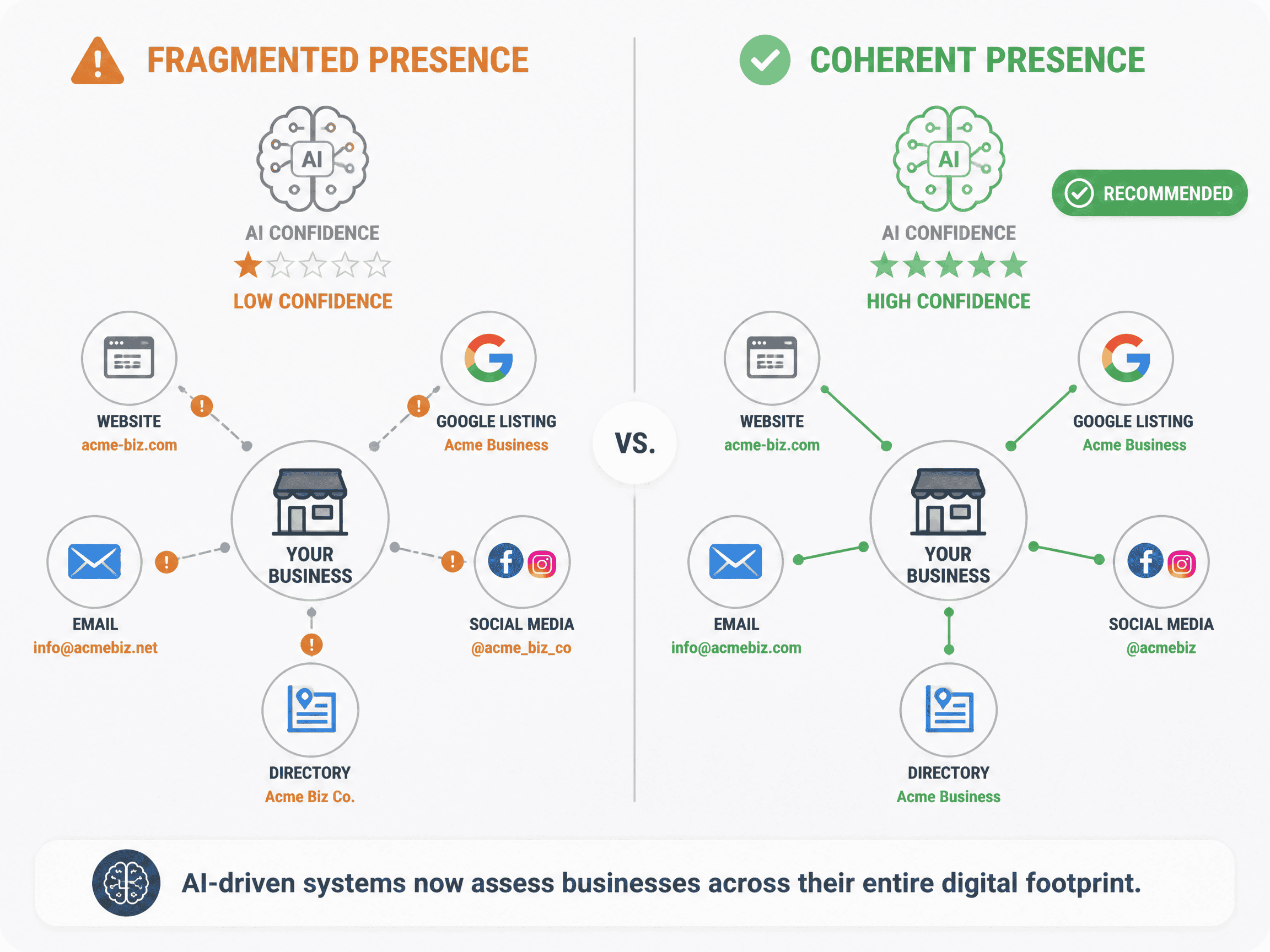
According to recent analysis from Adobe, visibility in 2026 and beyond will depend less on page position and more on whether a brand is cited within AI-generated responses. This structural shift in search is already reshaping how businesses are found and evaluated.
How Technical Gaps Affect Sales and Marketing Performance
Technical inconsistencies in sales and marketing infrastructure directly impact business outcomes. Marketing campaigns and sales efforts operate on top of these foundations. When the underlying structure sends mixed or incomplete signals, even well-executed strategies deliver lower returns.
Common consequences include reduced visibility in AI-influenced results, longer sales cycles as prospects encounter friction during research, and difficulty achieving expected marketing ROI. Resources spent on content, advertising, and outreach produce weaker results when the technical “stage” on which they perform is compromised. Over time, this creates a measurable drag on growth.
Why This Divide Is Accelerating
Two converging trends are making technical coherence more consequential.
First, AI-mediated discovery continues to advance. Systems are becoming better at identifying and prioritizing businesses that present consistent, reliable information across channels. The cost of appearing fragmented is rising.
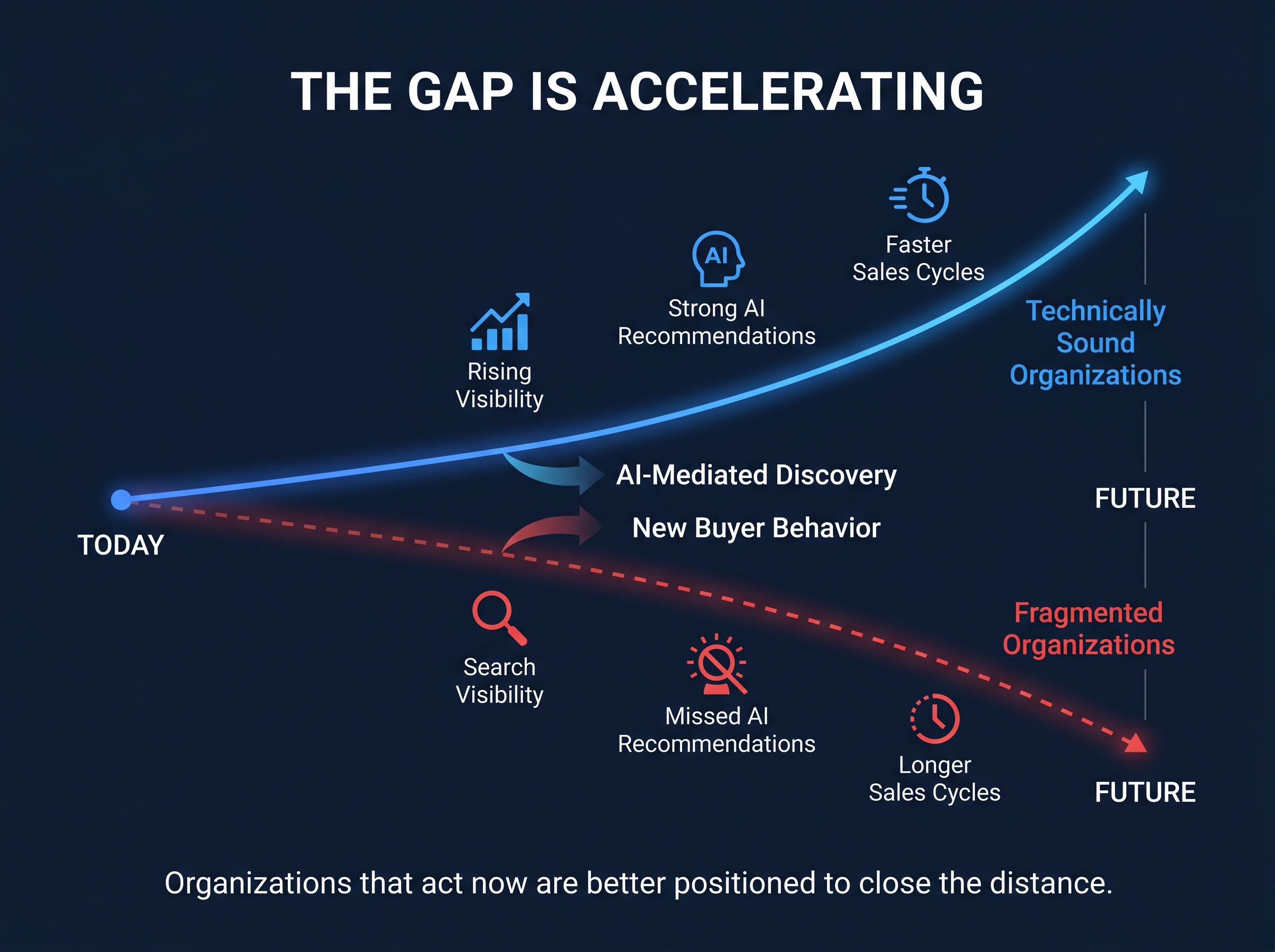
Second, buying behavior inside client organizations is changing. A new generation of business professionals approaches research and purchasing decisions differently from many senior leaders. They rely heavily on AI tools to identify options, compare vendors, and gather information. They respond to coherence and subtle signals of modernity and reliability. They are less likely to default to legacy or well-known brands that previous generations recognized automatically.
Recent Gartner research shows that B2B buyers are already progressing through critical buying tasks in more autonomous, digitally mediated ways, with a significant portion using AI during recent purchases. As these professionals — and forward-thinking senior leaders who are also adapting — gain greater influence over purchasing decisions, the criteria for standing out continue to shift.
The encouraging reality is that this gap, while widening, is not fixed. Organizations that begin addressing their technical sales and marketing foundations today are better positioned to close the distance and gain advantage as these trends mature.
A Practical Path Forward
High-performing organizations are beginning to treat their sales and marketing technical infrastructure with the same rigor applied to other critical business systems. Rather than attempting to diagnose complex issues internally, they use structured assessment to gain objective visibility into current state, identify gaps, and prioritize improvements.
The SMRA (Sales & Marketing Review Assessment) provides a professional, low-commitment way to evaluate this layer. It delivers clarity on where technical foundations may be limiting performance and creates a prioritized roadmap aligned with business objectives. This approach allows leadership teams to make informed decisions before investing further in strategy or execution.
Next Steps
Technical foundations in sales and marketing are no longer minor operational details. They are becoming material factors in visibility, trust, and results — especially as AI changes how businesses are discovered and as buying behavior evolves across generations.
The organizations that start strengthening these foundations now will be better positioned to perform as these dynamics continue to develop. Schedule a complimentary discovery meeting to discuss your current infrastructure or request the SMRA assessment for a structured review of where technical gaps may be affecting performance.